





Mirror Direction as per Vastu: Best Placement for Every Room

A mirror is more than a functional décor element. It can make a room feel brighter, larger, and more open. According to Vastu Shastra, however, the direction and placement of a mirror are considered important because mirrors are believed to reflect and amplify the energy of a space.
So, which direction should a mirror face as per Vastu? In general, the north and east directions are considered the most suitable for mirror placement, while the south-west is traditionally avoided. The ideal placement can also vary depending on whether the mirror is in the bedroom, living room, entrance, or dressing area.
In this guide, we explain the best mirror direction as per Vastu, including which walls to choose and which placements to avoid.
Which Direction Should a Mirror Be Placed According to Vastu?
According to traditional Vastu principles, a mirror is generally recommended on the north or east wall. These directions are associated with positive energy and are commonly preferred for reflective surfaces.

Mirror direction according to traditional Vastu guidance: north and east are generally preferred, west may be considered depending on the room layout, while south and south-west are commonly avoided.
If you are deciding which wall to place a mirror on as per Vastu, consider:
- North wall: Generally considered favourable.
- East wall: Generally considered favourable.
- West wall: Can be used depending on the room and layout.
- South wall: Traditionally avoided where possible.
- South-west direction: Generally considered unsuitable for mirrors.
The exact placement should also take into account doors, windows, beds, and the overall layout of the room.
Mirror Direction as per Vastu for the Bedroom
When it comes to mirror direction in the bedroom, placement requires additional care. A commonly followed Vastu recommendation is to place the mirror on the north or east wall.
One of the most important bedroom guidelines is to avoid placing a mirror directly opposite the bed. According to traditional Vastu beliefs, a mirror reflecting the bed may create an unsettled atmosphere and disturb restful energy.
If you already have a dressing table or a full-length floor mirror, position it so that the mirror does not directly reflect the bed.

Nira Wooden Floor Mirror
The Nira Wooden Floor Mirror combines a tall full-length glass mirror with an Acacia wood frame in a warm walnut finish. Its sculptural wavy sides give a bedroom or dressing corner visual character without requiring additional wall decor.
Vastu styling tip: Position a full-length mirror where it is convenient for dressing while ensuring that the reflective surface does not directly face the bed.
View Product DetailsWhere to Place a Mirror in the Bedroom?
For a bedroom, you can consider:
- A mirror on the north wall
- A mirror on the east wall
- A dressing mirror positioned so it does not reflect the bed
- A wardrobe mirror placed where its reflection is comfortable and practical
If the mirror is unavoidable opposite the bed, some traditional Vastu practitioners recommend covering it while sleeping.
Dressing Table Mirror Should Face Which Direction?
A frequently asked question is, “Dressing table mirror should face which direction?”
For a Vastu-oriented bedroom, a dressing table mirror is generally preferred on the north or east side. The objective is to position the mirror so that it does not directly reflect the bed.
Instead of focusing only on the direction the mirror “faces,” consider the wall on which the mirror is installed and what it reflects. A well-positioned dressing mirror should provide comfortable visibility without creating an unwanted reflection of the sleeping area.

Yoho Floor Standing Mirror
The Yoho Floor Standing Mirror features a slim full-length form with a mild steel frame in a gold finish. Its visually light structure makes it useful in bedrooms and dressing areas where you want a practical mirror without adding a heavy furniture piece.
Vastu styling tip: Keep the mirror slightly away from the direct line of the bed and position it where the reflection remains practical and visually calm.
View Product DetailsCan We Place a Mirror on the South Wall?
According to traditional Vastu guidelines, the south wall is generally not considered the first choice for a mirror. Since mirrors are reflective surfaces, Vastu recommendations often favour the north and east zones instead.
If your room layout leaves no practical alternative, consider consulting a Vastu professional rather than moving the mirror solely based on a general rule. Functional requirements, room proportions, doors, windows, and existing furniture should also be considered.
Can We Place a Mirror on the West Wall?
A mirror on the west wall is generally considered less preferred than the north or east wall in many Vastu recommendations, but it is not necessarily treated the same way as a south-west placement.
If the west wall is the most practical location, ensure that the mirror does not create an uncomfortable reflection, such as directly reflecting the bed or an undesirable part of the room.
Mirror Placement in the Living Room as per Vastu
The living room offers more flexibility when deciding where to place a mirror as per Vastu. A mirror can be used as a decorative feature while also making the space appear more spacious and brighter.
The north or east wall is commonly preferred. You can position a decorative mirror where it reflects:
- Natural light
- A pleasant view
- A well-designed part of the room
- An attractive artwork or décor arrangement
Avoid using a mirror to highlight clutter, an untidy corner, or an undesirable view.
A statement wall mirror can also work beautifully above a console table, provided its placement aligns with the room's overall layout.

Regalia Oval Wall Mirror
The Regalia Oval Wall Mirror combines an elongated oval glass surface with detailed metal accents and a brass finish. Its vertical form works particularly well on narrower living room, hallway, or dressing-area walls.
Vastu styling tip: An elongated wall mirror can be useful when you want to enhance light and vertical depth without covering a large section of the wall.
View Product DetailsMirror at the Entrance as per Vastu
Mirror at the entrance is another area where placement matters. A mirror can be useful near an entryway, especially as part of a console or foyer arrangement.
However, traditional Vastu guidance commonly recommends avoiding a mirror directly opposite the main entrance door, as it is believed to reflect energy back outside.
Instead, if the layout permits, consider placing the mirror on a side wall rather than directly facing the entrance.

Ekatra Wooden Wall Mirror
The Ekatra Wooden Wall Mirror combines a full-length mirror with an Acacia wood frame, integrated shelving and woven detailing. Its wall-mounted design can be useful in dressing areas or entry spaces where floor space is limited.
Vastu styling tip: In an entrance area, consider installing a functional wall mirror on a side wall rather than directly opposite the main door.
View Product DetailsMirror in South-West Direction as per Vastu
The south-west direction is traditionally considered one of the directions where mirrors should generally be avoided.
If you are specifically wondering about mirror placement in the south-west, it is better to choose another wall where possible. The north or east wall can usually provide a more Vastu-aligned alternative.
Where Should You Place a Floor Mirror as per Vastu?
A floor mirror follows many of the same traditional Vastu considerations as a wall mirror. Its main advantage is flexibility because it can often be repositioned without permanently changing the room.

Floor mirror placement according to traditional Vastu guidance: north and east are commonly preferred, west can be considered depending on the room, while south and south-west are generally avoided.
When positioning a floor-standing mirror:
- Prefer a north or east zone where practical
- Avoid directly reflecting the bed
- Keep it clear of busy walking paths
- Use it to reflect natural light or a pleasant view
- Make sure the mirror stands securely and does not feel visually crowded by nearby furniture
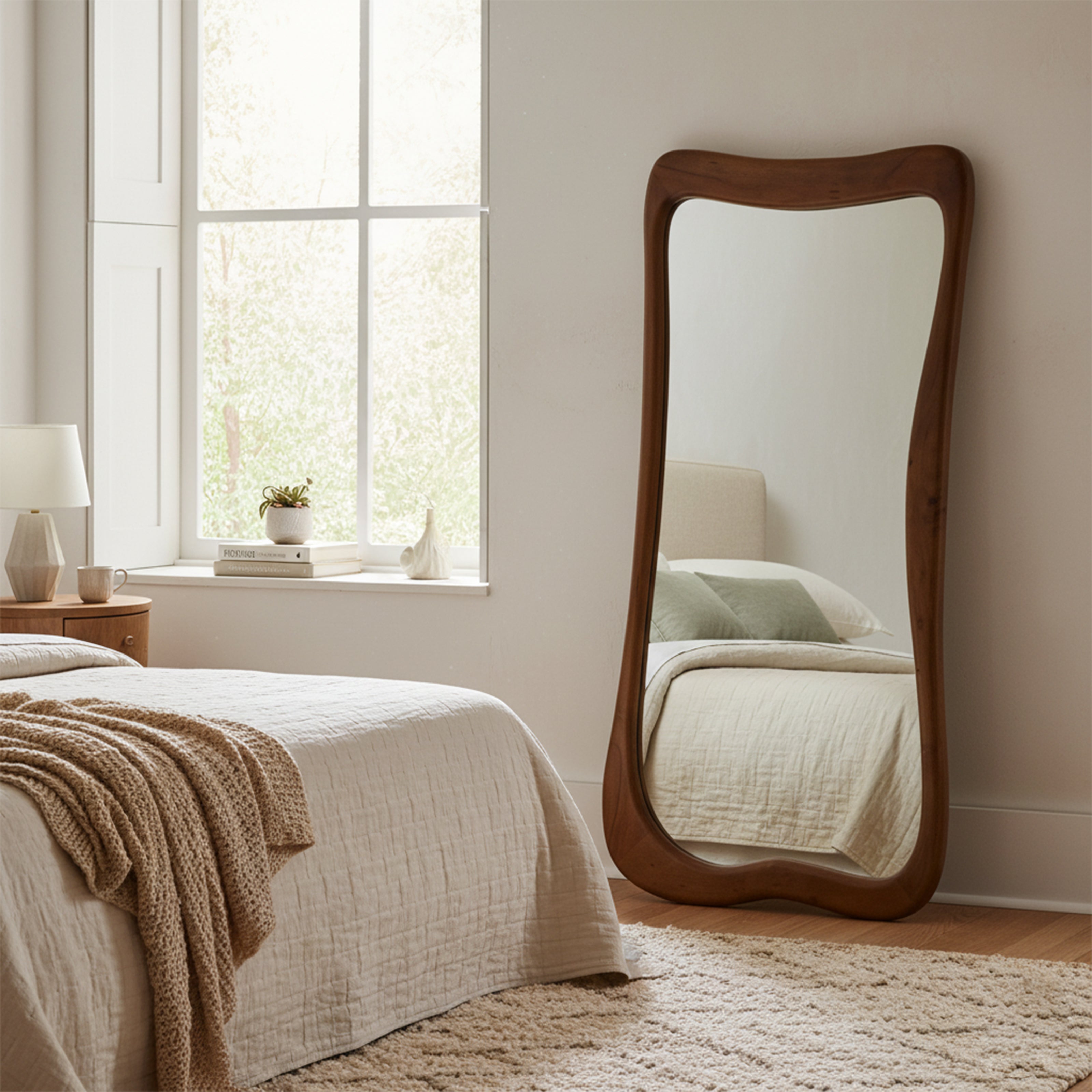
Mehraab Floor Standing Mirror
The Mehraab Floor Standing Mirror features a tall glass mirror framed in Acacia wood with softly flowing curves and a warm Gaj finish. Its full-length scale makes it suitable for bedrooms, dressing corners and spacious entry areas.
Vastu styling tip: Use the flexibility of a floor-standing mirror to adjust its position until it provides a useful reflection without facing the bed or an undesirable part of the room.
View Product DetailsWhere Should a Mirror Be Placed as per Vastu?
For a simple answer, follow these general guidelines:
| Mirror Placement | Traditional Vastu Guidance |
|---|---|
| North wall | Generally preferred |
| East wall | Generally preferred |
| West wall | Can be considered depending on layout |
| South wall | Generally avoided |
| South-west | Generally avoided |
| Directly opposite bed | Avoid |
| Directly opposite main entrance | Generally avoid |
| Living room north/east wall | Commonly preferred |
| Floor mirror | Prefer north/east and avoid reflecting the bed |
Final Thoughts
Choosing the right mirror direction as per Vastu involves more than simply selecting a compass direction. The mirror's reflection, room layout, furniture arrangement, and purpose all matter. As a general guideline, north and east walls are preferred, while south and south-west placements are traditionally avoided.
For bedrooms, the most important consideration is to avoid a direct reflection of the bed. In living rooms and entrances, use mirrors strategically to reflect light, enhance spaciousness, and complement the interior design.
The type of mirror also matters from a practical styling perspective. A wall mirror can create a focal point without occupying floor space, while a floor mirror gives you greater flexibility to adjust its position according to the room layout.
Frequently Asked Questions
Which direction should my mirror face?
According to traditional Vastu guidelines, mirrors are generally recommended on the north or east walls. When placing a mirror, also consider what it reflects. Avoid positioning it where it directly reflects the bed, main entrance, clutter, or an undesirable view.
Where to avoid mirrors according to Vastu?
According to traditional Vastu beliefs, mirrors are generally avoided in the south and south-west directions. It is also commonly recommended to avoid placing a mirror directly opposite the main entrance or bed. If possible, choose a north or east wall instead.
Where should mirrors be placed for good luck?
In Vastu, mirrors are traditionally considered most suitable on the north or east walls, as these directions are associated with positive energy. In a living room, placing a mirror where it reflects natural light or an attractive view is also considered preferable.
Can I use a floor mirror according to Vastu?
Yes. A floor mirror can be used while following the same general placement principles as a wall mirror. North and east are commonly preferred, and the mirror should ideally not directly reflect the bed or main entrance.
Which direction is good for a mirror according to Vastu?
The north and east directions are generally considered the best directions for mirror placement according to traditional Vastu principles. For bedrooms, the mirror should ideally be positioned so that it does not directly reflect the bed.
Can an Orange Tree mirror be placed above a console table?
Yes. An Orange Tree wall mirror can be styled above a console table in an entryway, living room, or hallway. If following Vastu principles, avoid positioning the mirror directly opposite the main entrance and consider a side wall instead.
Where should I place an Orange Tree mirror according to Vastu?
For a Vastu-conscious interior, an Orange Tree floor or wall mirror can generally be placed in the north or east zone. The final position should also consider the room's layout, practical use, and what the mirror reflects.
Are Orange Tree mirrors suitable for modern and premium interiors?
Yes. Orange Tree offers wall mirrors and floor mirrors in wood, metal, glass, and decorative finishes that can complement modern, contemporary, and premium interiors.


