





Round vs Rectangular vs Oval Dining Table: Which Fits Your Home?

Quick answer: Round dining tables usually work well for four people in a square room. Rectangular tables make better use of long rooms and are practical for larger families. Oval tables offer a similar length to rectangular ones, with curved ends that can make moving around the table feel easier. The right shape depends on your room, your chairs and how many people eat together.
Think of a Sunday lunch at home. Everyone is settling into their chairs, someone is carrying another serving bowl from the kitchen, and there's always room to make for one more guest.
These little moments say a lot about the dining table you need. A round table keeps everyone facing each other. A rectangular table gives the meal room to spread out. An oval table offers that lovely long surface, but without the sharp corners.
So, when you're comparing a round vs rectangular dining table, should an oval table be on your list too? Absolutely. Let's look at all three through the things that matter at home: space, seating and the way your family lives.
Round vs Rectangular vs Oval Dining Table: What's the Difference?
You might notice the shape first. But once the table is at home, it's the space around it that you'll notice every day. Can everyone pull out a chair easily? Is there enough room for the food? Does someone have to squeeze past the corners on the way to the kitchen?
| What matters | Round | Rectangular | Oval |
|---|---|---|---|
| Room layout | Square dining area or nook | Long or narrow room | Long, open-plan dining space |
| Seating | Especially comfortable for 2–4 | Practical for 4–8 or more | Often works well for 6–8 |
| Conversations | Everyone faces the centre | More distance along long tables | Easy conversations along curved ends |
| Serving dishes | Easy to share on smaller tables | Generous space along the centre | Good central space, narrower ends |
| Walking around | No corners, but needs width | Corners need attention | Curved ends feel less intrusive |
There isn't a winner in every row. That's a good thing. It means you can choose based on your room rather than following a rule that may not work for you.
Which Shape Will Feel Right in Your Dining Room?
Picture where your table will actually stand. Is it a square corner beside the living room? A narrow space between the kitchen and a wall? Or a larger dining area that you can walk around?
A square dining corner
In a square dining corner, a round dining table can feel beautifully balanced. The chairs gather around one centre, and nobody takes the seat at the end. For a family of four, it's often a simple, comfortable arrangement.
But a compact rectangular table can also be a smart choice if the room is narrower than you think. An oval table might feel softer, although its added length isn't always useful when only four people dine together.
What we'd look at first: a round four-seater for a genuinely square nook, or a compact rectangle for a narrow one.
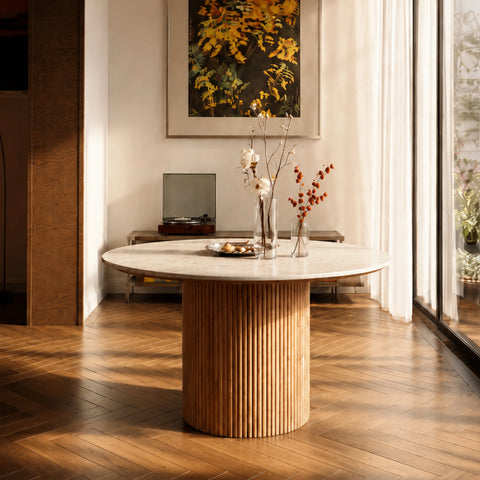
Kotaro Dining Table 4 Seater
If you love the idea of sitting together around a round table, Kotaro shows how a central pedestal can give the design a clean, sculptural look. Its 120 cm top is a useful size to picture in a four-person dining corner.
Worth checking: allow enough space around the full diameter for chairs, even though the table has no corners.
View Product DetailsA longer dining room
This is where a rectangular dining table starts to make sense. It follows the room's length and gives you room for people on both sides without needing the width of a large round table.
An oval table can work just as well. It still offers a long surface, but its curved ends soften the outline. If your room is narrow, though, compare the actual width of both tables rather than choosing oval simply because it looks lighter.
When the dining space is part of your living room
Many Indian homes have a dining area between the living room and kitchen. You walk past it all day, not just at mealtimes.
A rectangular table can give that part of the room a neat, defined feel. An oval dining table may be easier to walk around where the route passes close to its ends. A round table can look lovely too, particularly if the space opens into a square corner.
With oval tables, the advantage is usually the softer path around the corners, not a dramatic saving in floor space.
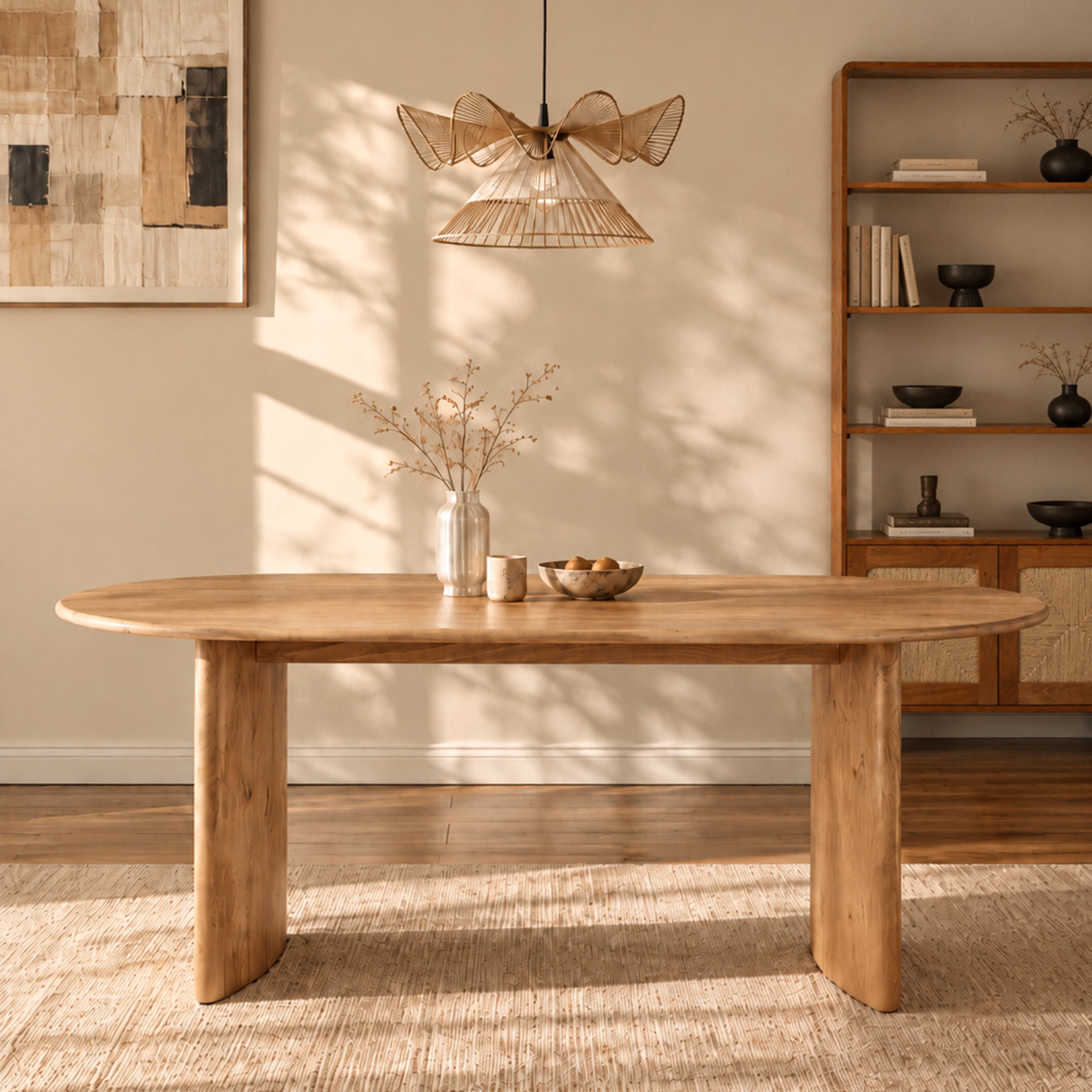
Saanra Wooden Dining Table
Saanra gives the oval shape a calm, modern feel. Its Light Mango Wire Brush finish keeps the wood's texture visible, while the panel-style legs create a distinctive profile.
Why it fits here: the long oval top is worth considering when you want six seats but prefer softer lines in an open living-dining area.
View Product DetailsDoes a Round Table Actually Save Space?
You've probably heard that round tables are best for small homes. Sometimes that's true. But the room's width matters more than the absence of corners.
A round four-seater with a 120 cm diameter needs about 300 cm of clear width if you leave 90 cm around it for chairs. Now take a rectangular six-seater measuring 180 × 90 cm. With the same allowance, it needs roughly 360 × 270 cm.
Surprisingly, the longer table can seat more people while needing less room width. An oval table measuring 180 × 90 cm needs a similar overall clearance area to that rectangle. Its rounded ends may make movement feel easier, but they don't remove the need for chair space.
These are approximate planning footprints, not guaranteed minimum room sizes. Doors, storage furniture, chair dimensions and walkways can increase the space required.
Here's a simple idea before you buy: mark the table's dimensions on the floor with masking tape. Then picture the chairs pulled out. Can someone get to the kitchen while another person is seated? Can the crockery cabinet still open?
That little test tells you more than a tabletop photograph. If you'd like measurements for other seating capacities, our dining table dimension guide goes into the sizes in more detail.
What Works Better for Four, Six or Eight People?
Think about how many people sit down together on an ordinary day. Buying for the occasional party can leave you with a table that's too large the rest of the year.
When it's usually four of you
A round table around 105–120 cm across makes it easy for everyone to join the same conversation. A rectangular four-seater may be a better fit in a narrow room or when you need a little extra surface for serving dishes. An oval four-seater is another lovely option, although its longer shape isn't always necessary for four.
When six people eat together
A rectangular table around 180 × 90 cm gives you a familiar arrangement: two chairs along each long side and one at either end. An oval table of similar length can also seat six, as long as its curved ends and base leave enough room for the chairs.
A six-person round table generally needs a diameter of about 135–150 cm, depending on the chair width and supporting base. That makes it a better fit for a broad dining area than a narrow one.
For a family of six: rectangular and oval are often the easiest starting points. Choose round when your room has the width and you really want everyone facing the centre.
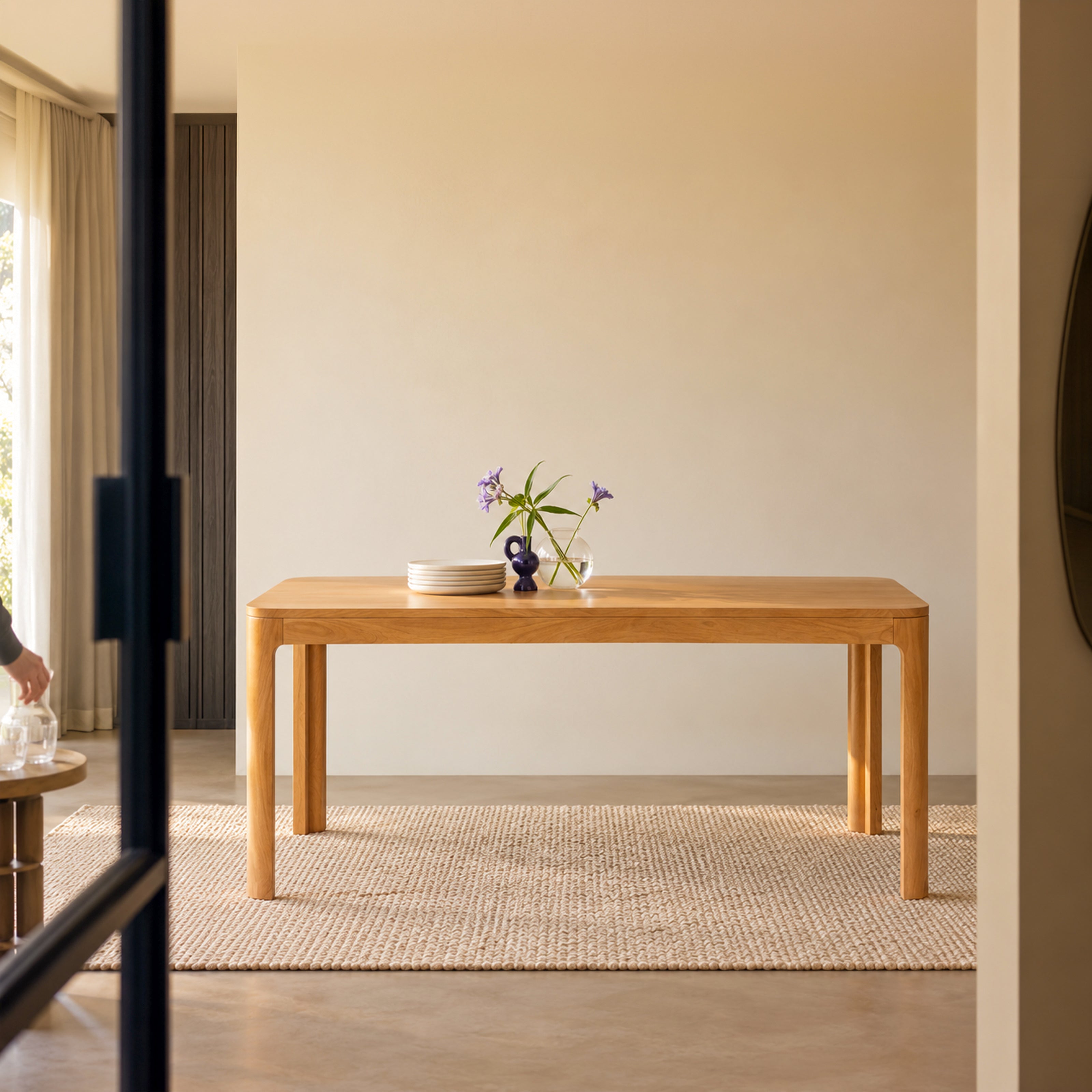
Portico 6 Seater Dining Table
From the new Portico collection, this six-seater gives a familiar rectangular layout a softer feel. Its Golden Oak finish, rounded edges and four turned column legs bring character without losing the practical length families need.
Why it fits here: it's a useful real-world example of a six-seater that balances shared dining space with a warm, considered design.
View Product DetailsWhen everyone comes over
In a larger family, someone may be having a late breakfast while somebody else is getting ready for lunch. And on weekends, the table may be full of people and shared dishes.
A longer rectangular table makes it straightforward to seat eight. An oval eight-seater can also work beautifully, especially when you want the softer outline in a spacious room. A round table for eight needs a much wider area, and the centre can become difficult to reach.
For large families, look beyond the advertised number of seats. The width of the chairs and the space between the table legs make a real difference.
Think About the Meals You'll Share Around It
There's a difference between a quick breakfast and a Sunday lunch with everyone passing bowls across the table. A smaller round table keeps shared dishes easy to reach. But when you increase its diameter, the middle gets farther away.
Rectangular tables give you a long centre for plates, bowls and serving dishes. Oval tables offer much of the same space, although their curved ends leave slightly less usable surface than a rectangle of the same overall size.
If you often host guests, think about conversation too. Round seating feels close and inclusive. Rectangular seating can accommodate a larger group more efficiently. Oval tables make a pleasant middle ground when you want room for guests without such a strong, straight outline.
And if children often use the table for drawing or homework, think about what feels comfortable outside mealtimes. Rounded corners may be helpful in a busy home, but stability and appropriate chair space are just as important.
Don't Forget the Space Under the Table
Two tables can look equally spacious from above and feel very different when you're sitting at them. Often, it's because of the legs.
A round pedestal table can let you move chairs around more freely, although a wide base might still get in the way of your feet. A rectangular table may give you clear space between its corner legs, but an apron beneath the top can reduce knee room. An oval table with panel-style supports needs the same careful look, especially near the curved ends.
For example, the new Kanso 6 Seater Dining Table is another rectangular design at 180 × 90 × 76 cm, but its solid oak construction and open, apron-free underframe give it a different seating experience from Portico. The two are worth comparing when chair clearance is your main concern.
If you're choosing chairs separately, check the armrest and seat heights, and make sure the chairs can slide beneath the tabletop. Our dining chair dimensions guide can help with that final fit.
Which Shape Will Suit the Way Your Home Looks?
By now, you probably have a shape in mind. The enjoyable part is choosing how it should feel in your room.
A round table doesn't have to look traditional. Kotaro combines a marble top with a ribbed wooden pedestal, while the Le Dame Wooden Dining Table takes a fully wooden, sculptural approach.
Rectangular tables don't have to look formal either. Portico's turned legs and curved apron make its straight tabletop feel soft, while Kanso's open underframe has a quieter, lighter presence.
For oval tables, Saanra offers a simple wooden look. If you prefer a more sculptural base, the Gahana Oval Dining Table is another option to consider, available in six and eight-seater versions.
These are different designs serving different rooms. The right one is the table that looks natural in your space and still works when all the chairs are occupied.
What About Material and Durability?
If you're buying a table for daily meals, you'll want it to feel sturdy and stand up to normal use. But durability is less about round, rectangular or oval and more about the material, construction and finish.
Wooden tables bring warmth and natural texture. Marble-top designs offer distinctive veining, but natural marble needs care around acidic spills, heat and harsh cleaning products. Whichever material you prefer, use coasters, wipe up spills and follow the care advice for the actual finish.
If wood species are part of your decision, our comparison of sheesham, mango and acacia wood explains how their characteristics differ. You can then focus on the table's shape without worrying that you're overlooking the material.
So, Which Dining Table Shape Should You Choose?
Maybe you love the idea of four people sitting around one small round table. Maybe your family needs a long table where everyone can eat together. Or perhaps the softer ends of an oval table are exactly what your living-dining space needs.
Here's a simple way to bring the choice together.
| Your home or routine | Shape to consider first | Why |
|---|---|---|
| Small square dining nook | Round | Balanced layout for smaller groups |
| Long, narrow room | Rectangular | Uses the room's length efficiently |
| Open living-dining area | Oval or rectangular | Both suit a longer dining zone; oval softens the corners |
| Family of four | Round or compact rectangular | Choose by the room's proportions |
| Six or eight regular diners | Rectangular or oval | More straightforward seating for bigger groups |
| Frequent family gatherings | Rectangular or oval | Useful length for chairs and serving dishes |
Use that as a starting point, not a rule. Before buying, measure your room, leave space for chairs and check how the table base works with the people sitting around it.
Once you know the shape and number of seats, you can look at dining tables in wood and marble with a clearer idea of what will actually fit. Take a moment to check the base, finish and chair clearance before making your choice.
A dining table should feel right on an ordinary day, not only when the room is styled for a photograph. That's what makes it a piece you enjoy gathering around for years.
Frequently Asked Questions
1. Is a round or rectangular dining table better for a small room?
A round table can work beautifully in a small square dining area, while a compact rectangular table may fit better in a narrow room. Measure the full space required for the table and chairs rather than judging the tabletop alone.
2. Is an oval dining table better than a rectangular one?
An oval table is worth choosing when you want a long dining surface with softer corners. A rectangular table usually gives you more usable edge and surface space within similar outer dimensions. Neither is always better; the room layout and seating arrangement decide.
3. Which dining table shape is best for a family of four?
A round table around 105–120 cm across is often comfortable for four in a square room. In a narrow room, a compact rectangular table may fit better. Check the tabletop width and chair space when comparing four-seater dining tables, rather than choosing by shape alone.
4. Which dining table works best for a large family?
Rectangular and oval tables usually make seating six to eight people easier because they offer more length without needing the width of a large round table. For a family of six, compare the leg positions and chair space across six-seater dining tables. If eight people eat together regularly, choose a proper eight-seater instead of squeezing in extra chairs.
5. What are the most durable kitchen or dining table designs?
Durability depends more on wood or stone quality, joinery, support and protective finish than on table shape. A well-constructed solid wood table can suit everyday use; natural marble requires extra care around acidic spills and heat.
6. Can a round dining table seat six people comfortably?
Yes. A round table around 135–150 cm in diameter can often accommodate six people, depending on chair width and base design. It will generally need a wider room than a rectangular six-seater.
7. Do round dining tables take up less space than rectangular ones?
Not necessarily. A round table may suit a square room, but its full diameter needs clearance on every side. A rectangular table can seat more people while taking up less room width in a long or narrow space.
8. Can dining chairs fit completely under a round table?
They can, but it depends on the pedestal or leg design and the height of the chairs, particularly their armrests. Check the clear space under the tabletop and whether the base obstructs feet. If you are buying the table and chairs together, check their individual dimensions even when they come as a set.
9. Which dining table shape is best according to Vastu?
Traditional Vastu advice often favours square or rectangular dining tables because they are associated with stability and balance. These are traditional beliefs, not scientifically established effects. Comfort, circulation and room proportions matter too.
10. Does Orange Tree have round, rectangular and oval dining tables?
Yes. Orange Tree has designs in all three shapes, with different seating capacities, materials and supporting structures. Looking at actual measurements, chair fit and table bases will help you choose one that suits your home.


